
Does veganism cause more insect and animal deaths?

One of the arguments that is often used against veganism is that veganism causes more animal and insect deaths than eating meat. In interviews, online and in social media, this point comes up again and again. The idea is simple: if people don't eat animals, they'll need to switch to plants. Plants don't contain as many calories per 100g serving as meat does. This means growing more plants to feed people. Growing plants involves clearing land, ploughing and other destructive practices. So, more plants = more destruction, right?

How farming affects animal and insect deaths
Farming, whether for animal agriculture or plant-based food, inevitably impacts wildlife. Clearing land for crops or pastures destroys habitats. Machinery and pesticides kill insects and small animals. But the scale and type of harm varies widely according to the activity.
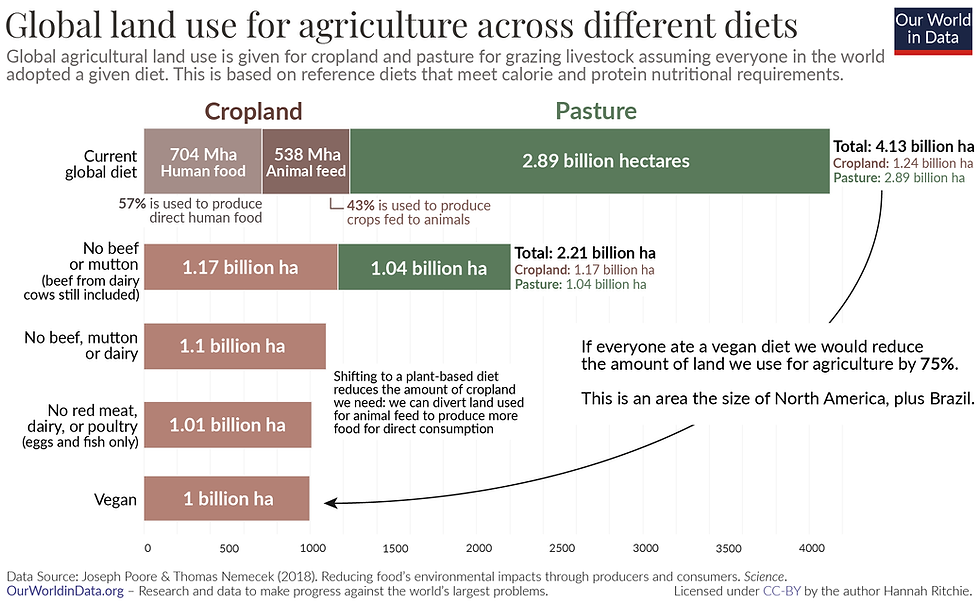
Animal agriculture involves raising animals like cows, pigs, and chickens for meat, dairy, fish and eggs. This system requires large amounts of land, water, and feed crops. As shown in the chart below, farming animals for food requires that 43% of all crops grown are used to produce animal feed. This uses 538 million hectares of land globally, while pasture takes up 2.89 billion hectares of land globally each year. All of this land use leads to habitat loss for wild animals from forest and grassland clearance for conversion into grazing land or feed crop fields. The land clearance, and then land use, destroys habitats, pollutes the environment and drains the soil of nutrients and health while causing small animal and insect deaths.
Vegan food production mainly involves growing plants such as grains, vegetables, fruits, nuts, and legumes. This still causes some insect deaths, for example, from pesticide use and soil disruption. However, it requires less land and water than animal agriculture. This means that, even if everyone on the planet were to go vegan, no land would be used for pasture, and the effective waste of feeding a whole animal, to only eat a small part of it, would be eliminated.
Would more animals die if everyone went vegan?
If the entire population switched to a vegan diet, farming would shift dramatically. Demand for animal products would drop, reducing the need for livestock farming. More land would be freed from grazing and feed crops. This land could be restored to natural habitats or used for more efficient plant farming.
While some insect deaths would continue due to crop farming, the total number of deaths would decrease. Animal agriculture directly kills billions of sentient animals. Plant farming indirectly kills insects and small animals, but in smaller numbers relative to the scale of animal slaughter.
Does veganism cause more insect and animal deaths?
Among farming activities, animal agriculture causes the most harm to animals and insects combined. Here’s why:
Land use: Animal agriculture uses about 77% of global farming land but produces only 18% of calories. This inefficiency drives large-scale deforestation and habitat loss. These actions directly kill billions of animals and insects each year.
Direct animal deaths: Billions of farmed animals are killed annually for meat, dairy, and eggs, even more for fish and seafood, which are often farmed on cleared land in ponds. These actions directly kill billions of animals and insects.
Indirect animal deaths: According to the paper, Field Deaths in Plant Agriculture, many animal deaths that happen in plant agriculture don't come at the hand of humans. In fact, a significant proportion of the deaths are from predators, such as owls. Small animals attracted to crops will get the attention of larger animals that naturally eat them. Are humans responsible for these deaths? This is hard to quantify. If the crops weren't there, the animals would not come; however, if the crops weren't there, the animals most likely would not have bred from lack of food supply. Humans have not set out to cause this problem; it is animals taking advantage of human activity.
Insect deaths: Feed crop farming for livestock uses pesticides and heavy machinery, killing insects and small animals.
Environmental damage and pollution: Animal agriculture generates significant greenhouse gas emissions, water pollution from manure, and soil degradation.
Crop farming for vegan food also causes harm, mainly due to the scale required, but this damage tends to be more localised and less severe. For example, monoculture crops like corn and soybeans rely heavily on pesticides, which harm insect populations. But these crops require less land overall compared to animal agriculture. Also, most corn and soya is grown for animal feed, not human food. Nearly 80% of soya is grown for animal feed. If this crop was grown only for human consumption, less soya would be needed, meaning less land use, less water use, less pollution and less harm.
The harm caused by farming-related deaths
The deaths caused by farming have several consequences:
Loss of biodiversity: Habitat destruction and pesticide use reduce populations of wild animals and insects, threatening ecosystems.
Pollution: Runoff from animal farms and crop fields pollutes waterways, harming aquatic life.
Environmental damage: Deforestation and soil degradation contribute to climate change and reduce the land’s ability to support life.
Ethical concerns: The suffering and killing of billions of animals raises moral questions about how we produce food.
Reducing harm means addressing these issues together, not just focusing on one type of farming.
What can we do to reduce harm?
Everyone can take steps to reduce animal and insect deaths linked to farming:
Choose plant-based foods: Eating more vegan food reduces demand for animal agriculture, lowering overall harm. It is important to note that for every 100 calories that we feed to an animal, we only get 10 calories back. 90 calories are lost in growing the animal and keeping it alive. Eating those 100 calories ourselves is far more efficient. Also, livestock make up almost 55% of all biomass on the planet; wild animals only account for 5%. If the issue is reducing harm, then not breeding animals only to kill and eat them would have the greatest impact.
Support sustainable farming: Look for organic, regenerative, or agroecological farms that use fewer pesticides and protect habitats. It is also possible to grow plants in polycrop cultures. This is growing complementary crops together, reducing fertiliser and pesticide use while maximising land use efficiency.
Reduce food waste: Wasting less food means less farming is needed, which reduces harm. According to a UNEP report, approximately 1.05 billion tonnes of food are wasted every day.
Advocate for better policies: Support regulations that limit harmful pesticides, protect wildlife habitats, and promote sustainable agriculture. Sign petitions, contact local and national government, let them know that you care and will only vote for those who support better policies.
Grow your own food: Even small gardens can provide fresh produce with minimal harm to insects and animals. By growing your own food, you are in full control. You can choose to use natural fertilisers such as coffee grounds and nettle tea, which cause no harm to insects. You can deter pests by using fruit and vegetable peels around your crops. This provides feed for your plants as well as slugs and snails, while protecting your future harvest.
In conclusion, do vegans cause insect and animal deaths? Yes. It is an unfortunate truth. However, we cannot let the perfect be the enemy of the good. By eating a vegan diet and not using animal-based products, such as leather and wool, we save far more than just the animals on the farms.
To read more on how veganism affects the planets get a copy of our book, Going Vegan to Save the Planet.


